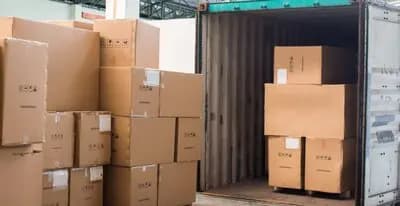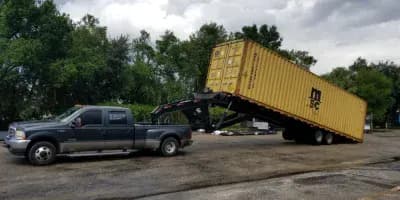

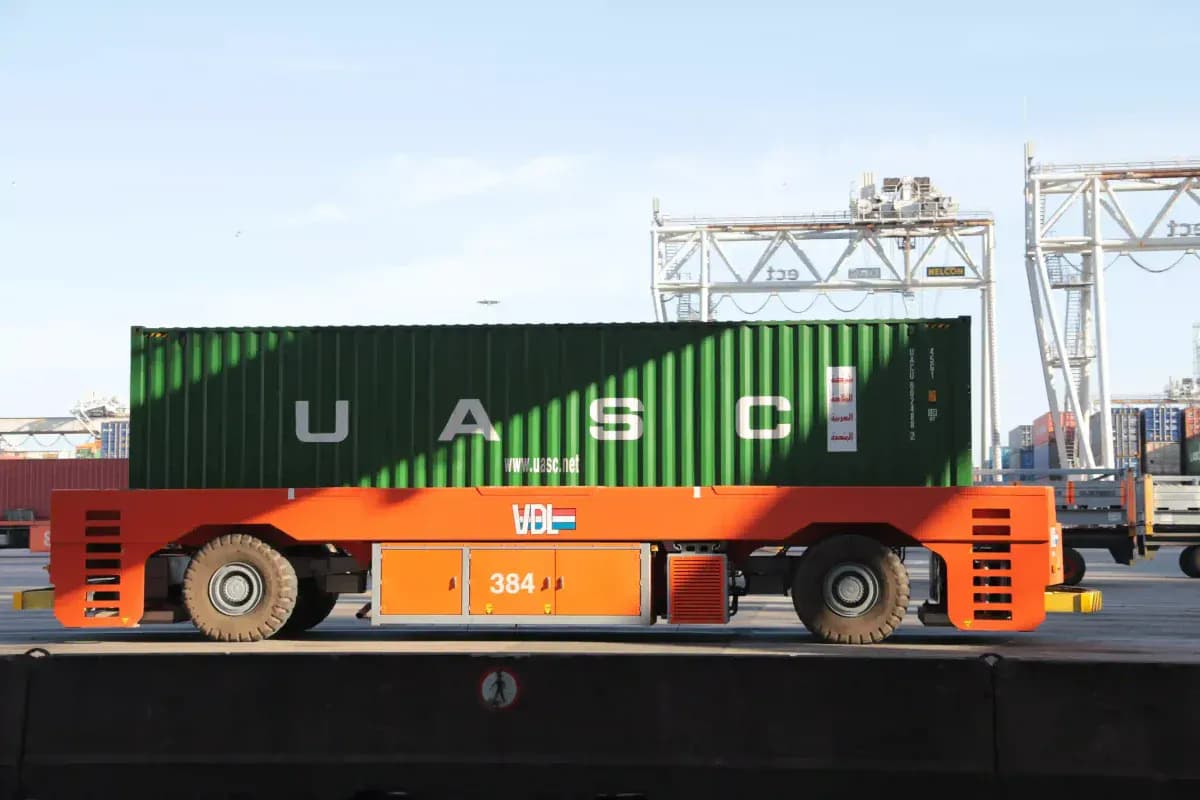
When you purchase a shipping container with Boxhub, you'll have three delivery options to choose from:
- Tilt-bed delivery: Your container is loaded onto a trailer that can tilt into the air, allowing the container to safely and roll off onto the ground. No additional offloading equipment is required.
- Flat-bed delivery: Your container is loaded onto a 40ft flat-bed trailer, often moved by a semi. This trailer is more common and, as a result, is often a little cheaper than tilt-bed delivery.
- Pick-up: You travel to a depot (with the right equipment!) to pick up your container yourself.
While flat-bed delivery can be more affordable, it's important to understand that specialized equipment is required to offload your container once it arrives. Without the proper equipment, you may face rescheduling and additional fees, such as a "dead-run fee," charged when the driver cannot complete the delivery.
Follow this guide to prepare for your delivery—and avoid unexpected fees.
Understand the Equipment Needed for Offloading
With flat-bed delivery, the container is placed on the trailer and cannot be tilted, so you'll need specialized equipment to safely offload it. The two most common options are cranes and forklifts.
- Cranes: A crane capable of lifting 5,000–8,000 lbs can lift any container from the flat-bed and place it exactly where you need it. Cranes are ideal for moving containers of all types and sizes.
- Forklifts: A forklift with the same lifting capacity (5,000–8,000 lbs) can offload containers only if they have forklift pockets.
Using a Crane to Unload a Shipping Container
Cranes are a great choice for accepting a flat-bed shipping container delivery because they don't rely on forklift pockets, meaning they can lift and place the container from the flat-bed trailer no matter the container's type or condition. Cranes also offer flexibility in terms of positioning at different heights and distances, making them a versatile option.
- Lifting Capacity: While most cranes are built for heavy lifting, it's important to make sure the crane you choose can handle the weight of your container. You can refer to our Shipping Container Size & Dimensions Guide to check your container's weight and compare it with your crane's lifting capacity.
Using a Forklift to Unload a Shipping Container
Forklifts can also be used to unload a shipping container from a flat-bed trailer—but only if your container has forklift pockets. Here's what you need to know:
- Forklift Pocket Dimensions: Forklift pockets are usually spaced 6 to 8 feet (1.8 to 2.4 meters) apart. The forklift's prongs must fit into these pockets, so you'll need a forklift with adjustable forks to accommodate the spacing. Standard forklifts may not fit depending on the container's dimensions.
- Lifting Capacity: Your forklift must also be capable of lifting at least 5,000 lbs (2,268 kg), which is the typical weight of an unloaded 20ft container. You can refer to our Shipping Container Size & Dimensions Guide to check your container's weight and compare it with the forklift's lifting capacity.
- Forklift Pocket Availability: Only new (one-trip) containers are guaranteed to have forklift pockets. If you've ordered a used container, we cannot guarantee that it will have forklift pockets, meaning you'll need to opt for a crane—or tilt-bed delivery—instead.
It's Your Responsibility to Provide the Equipment
Regardless of whether you use a crane or forklift, you are responsible for providing and arranging the necessary equipment for the delivery.
- Rent or Own: Be sure to either rent or own the appropriate equipment and have it available at the delivery site at the scheduled time.
- Driver's Role: Your driver will not be responsible for offloading the container or providing the equipment.
Plan Ahead to Avoid Dead-Run Fees
To avoid additional charges, ensure the proper equipment is in place before the delivery arrives. If the driver cannot offload the container because the necessary equipment isn't available, a dead-run fee will be charged to cover the driver's time and mileage for both driving to your property and returning the container to the depot.
Quick Checklist for Flat-Bed Deliveries
- Confirm Your Container Type: Is it new (one-trip) or used? This determines if forklift pockets are included.
- Choose Your Equipment: Decide whether you'll use a crane or forklift (if applicable).
- Check Forklift Compatibility: If using a forklift, ensure it can accommodate the pocket spacing (6–8 feet) and can lift at least 5,000 lbs.
- Verify Lifting Capacity: Ensure your equipment can lift at least 5,000 lbs (the typical weight of a 20-foot container).
- Ensure Equipment Availability: Confirm that your equipment is scheduled and ready to go at the delivery location at the scheduled time.
- Contact Us: Have questions? Get in touch before your scheduled delivery.
Questions? We're here to help!
Coordinating heavy equipment can be a new experience for some, and we're happy to assist. If you have any questions or need help ensuring your delivery goes smoothly, don't hesitate to reach out. We're here to help!